
Estimated reading time: 22 minutes
Catania, Sicily is often overlooked by travelers in favor of Palermo or Taormina—but those who linger discover one of the most character-rich cities in Italy. This travel guide covers where to stay, where to eat, and the best things to do in Catania, Sicily.
Why visit Catania, Sicily?
Though Catania is Sicily’s second-largest city, it remains surprisingly under the radar. With a relaxed vibe that can certainly turn on the party, Catania has long thrived nestled beneath the world’s most active volcano Mount Etna.
That contrast defines Catania: relaxed and chaotic, old and youthful, reverent and passionate! The people of Catania live for today while honoring the past.

Table of contents
How to Get to Catania, Sicily
No trip to Sicily is complete without a visit to Catania located on the eastern side of the island, about 60 miles from mainland Italy. Many people arrive via a short and inexpensive commuter flight from Rome. Catania–Fontanarossa Airport (CTA) is the busiest airport in Sicily and one of the busiest in Italy.
Once in Catania, the train system, bus network, or private tours connect visitors to Mount Etna and nearby tourist village of Taormina. We rented a car while exploring western Sicily and returned it at the airport before entering the city—a stress-free choice we’d recommend. We spent all of our 4 full days at Catania just exploring on foot.
Fall in Love with Catania

I’ll let you in on a secret… we enjoyed our entire trip to Sicily, but we fell in love with Catania.
During our visit to Catania, we indulged in amazing food and wine, saw what can only be described as miracles, and caught the infectious joy of the Catanesi for their patron saint.
Don’t treat Catania as a stopover—linger.
Where to Stay in Catania, Sicily
We booked our stay at the Palazzo Sangiorgio. With modern luxury inside, the outside holds on to the city’s roots with the beautiful ashy-colored volcanic stone of Mount Etna.


Hotel Location in Catania
The Palazzo Sangiorgio is tucked into a quiet piazza cul-de-sac. A two-minute walk brought us to St. Agata’s Cathedral and the Fountain of the Elephant, the heart of Catania’s historic center. We felt very safe both in the hotel and in the surrounding neighborhood.
Staff and Service
The staff was welcoming, professional, and always eager to help. The front desk arranged a city walking tour for us via WhatsApp before we arrived and a cab to the airport for departure.


Hotel Amenities, Room, and Price
Breakfast was excellent with many choices including savory and sweet traditional favorites. Choice of seating included the inside breakfast nook or the outside patio garden. A bar and lounge gave the front lobby a refined finish. The hotel also boasted a full spa which we were able to enjoy with a special rate.
Our superior double room included a comfortable bed, couch, and table with chairs without feeling cramped. A chilled bottle of prosecco awaited us upon arrival. The balcony overlooked the quiet piazza below.
Visiting the Palazzo Sangiorgio Hotel in January saved us roughly 30% compared to peak-season prices.


Where to Eat in Catania: What to Eat and Where to Find It
We love to eat and Catania’s restaurants did not disappoint! I have three restaurant recommendations plus a handheld and something sweet that you need to try.
Arancino: Catania’s Handheld Essential


Catania’s signature street food is the arancino: a pyramid-shaped rice ball, larger than a softball, with a breaded crust. Distinctly different in shape to Palermo’s arancina, both are the same inside–completely Sicilian in flavor!
Check out the post Where to Eat and What to Eat in Palermo to get to know the aracina.
Healthy Sweets at the Catania Street Markets


Little street markets abound in Catania. Just look for the umbrellas tottering on cables stretched over the pedestrian streets. “That’s where the party is,” said our city guide. Walking from the strong smell of the fresh fish market north into the narrow alleys of the pedestrian walking streets, the sweet smell of fresh squeezed juice wafts from every corner. Try the pomegranate with blood orange.
The Best Fresh Seafood in Catania


If you think lunch should take a second fiddle to the experience of a fancy dinner, think again. Any meal at the Ciauru i mari Restaurant, near the Piazza Ogninella,is a work of art. My meal was so pretty I had to ask the waiter to repeat the name of what I had ordered.
He said, “The dish is the name of the restaurant which translates to: The Smell of the Sea.” And he quickly added, “the good kind!”
The Best Pizza is with Suitcases


Pizza lovers will find a dizzying array of pizza varieties, and other meals, at the Pizzeria Deposito Bagagli just off University Piazza. The travel décor inside is ridiculously cute vintage. Make sure to take a walk around the entire restaurant and bar. Oh yeah, the pizzas are amazing too! At about 12 euro, its cheap and easily enough for two.
Eat Dinner in an Underground Lava Cave


The most unique dining experience in Sicily has got to be dining in the lava tube underneath the city of Catania at the A Putia dell’Ostello.
On the ground level, the large outside bar seating has a casual vibe. Inside nooks and crannies make this restaurant much bigger than I imagined.Down the narrow steps led us to the intimate, cave-side tables where the plates were amazing.
Visiting the softly lit cave is part of the mysterious and romantic experience. The stairs and short path follow an underground stream that is swallowed by the old lava flow. Repeated lava flows from Mount Etna played an important role in the history of the city. Reserve a table in advance through WhatsApp if you want a seat near the cave. The tables filled quickly even in January.
Pro tip. Impress your waiter with your appreciation for Sicily by ordering Mount Etna’s blood: Nero D’Avola (pronounced near-oh DAV-oh-la). A native Sicily we met told us, “All of Sicily is the volcano, warming the island from below,” a local told us. “The best wine on the island is from our mother’s chest, Etna.”
Best Things to do in Catania, Sicily


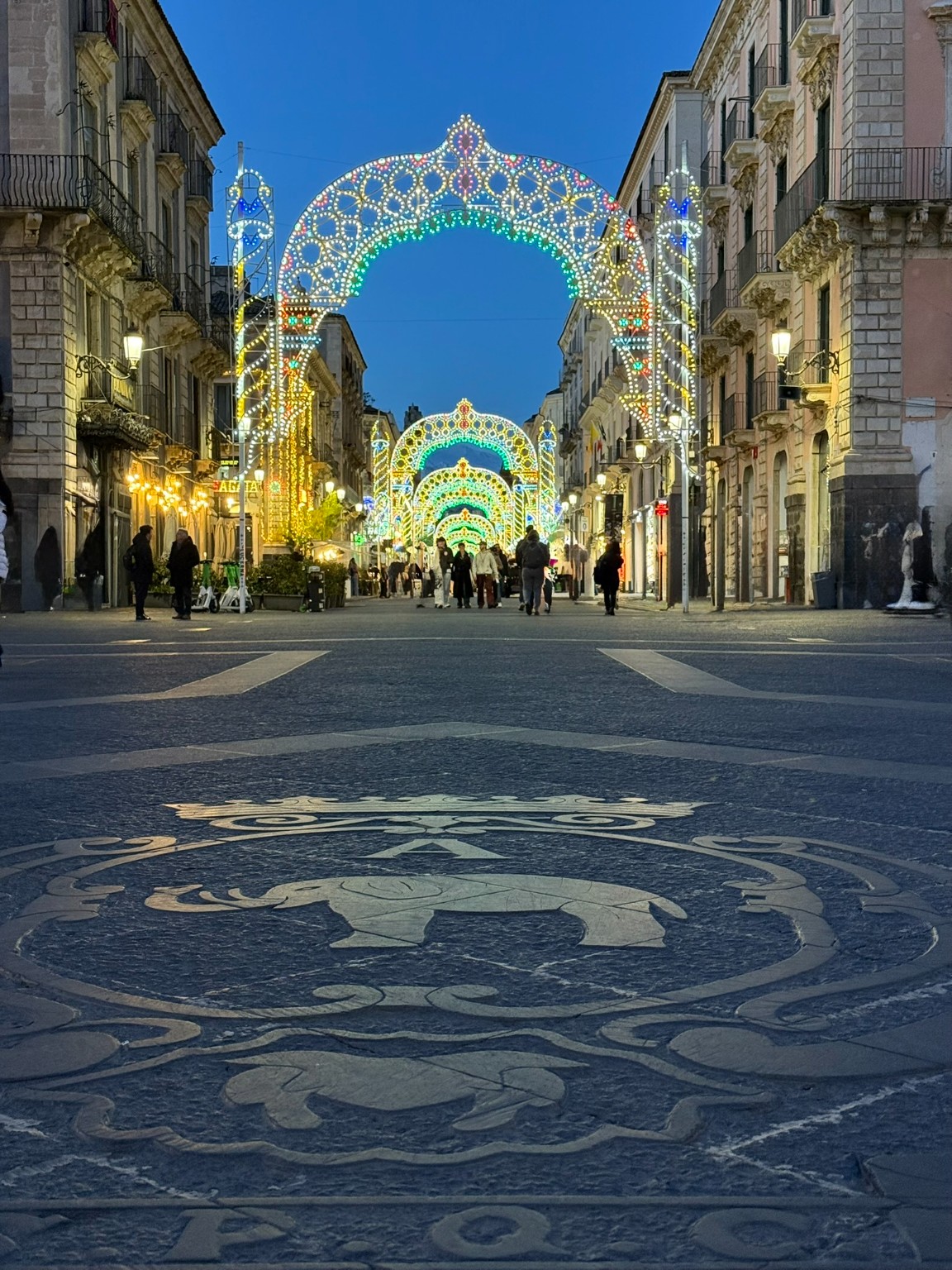
Catania itself is a hidden gem. The city’s lava‑rich soil has shaped everything from its architecture to its wine, giving buildings their distinctive cracked‑pepper hue. Via Etna, the main thoroughfare, is flanked by pedestrian streets that make the large city feel surprisingly walkable.
Travel tip… Pick up a planning map of Sicily before your trip!
The University of Catania—the oldest in Sicily—adds youthful energy as students move between campuses scattered throughout the old city.
Benedictine Monastery Turned University: the Best Tour in Catania


Built in the 1400s, the Monastero dei Benedettini di San Nicolò l’Arena is now part of the University of Catania but that’s not the only story it holds. To see its inner secrets, you must take a guided tour—visitors aren’t allowed beyond the first courtyard otherwise.
Hidden Roman mosaics lie beneath the library. Monks once ate meals delivered through lava caves below. Seismic instruments in the caves measured Etna’s tremors in the 1800s, and those same underground spaces now host to live theater performances. The tour ends on a marble staircase depicting Saint Agata’s martyrdom and the return of her remains.
Tip: The small group tours are in English and Italian alternately. Reserve a spot beforehand.
Back-to-Back Roman and Greek Theaters in Catania


Digging into Catania quite literally reveals history thousands of years old. Near the subway station, excavation uncovered a Roman amphitheater. A ten‑minute walk south brings you to an even older site—the Teatro Antico Greco‑Romano on Via Vittorio Emanuele II.
Both theaters offer self‑guided tours for a small fee. The Greco-Roman theater is the more extensive of the two, allowing access to the passageways behind the seating and a small indoor exhibit space.
While neither theater has the commanding views of Taormina or Segesta, something else happens here. The walls of modern Catania seem to grow organically from the stones of the past. For anyone interested in urban photography, these sites—and many others throughout the city—offer deeply dramatic scenes.
WWII Remembered: The Invasion of Sicily Museum


As amateur WWII buffs, we wanted to know more about this history in Sicily—how the operation went and how it affected the Sicilian themselves. There was no better place to visit than the Museo Storico dello Sbarco in Sicilia 1943, the Historical Museum of the Landing in Sicily in 1943.
The self-guided museum is an immersive experience in the best sense. Exhibits place you inside a bombed Sicilian village, then move you into an army pillbox bunker, onward to the armistice signing, and finally into a cemetery honoring the fallen. Other sections detail the five armies involved and each of the campaigns.
We spent three hours inside and still felt there was more to see. One thing to note: there’s no food on site or nearby, “tank up” before you get there! The museum is located just north of Catania’s central train and bus station, about a 20‑minute walk from our hotel along the Passeggiata alla Marina. It’s also a popular destination for student field trips, so you may want to visit in the afternoon rather than the morning. Always double‑check hours before going.
Exploring Saint Agata and the Heart of Catania
Piazza St. Agata—the city’s main duomo square—is the perfect place to orient yourself. Anchored by a smiling elephant obelisk, the piazza is lined with cafés and opens into pedestrian streets in every direction.
Two neighboring places of worship honor Saint Agata:
- Chiesa della Badia di Sant’Agata, the Church of St. Agata, faces the cathedral courtyard
- St. Agata’s Cathedral faces the piazza itself
The distinction reflects their importance. Chiesa is the generic Italian word for church, while duomo denotes the city’s principal church which is often the bishop’s seat (the cathedral).
The Chiesa of St. Agatha


Chiesa della Badia di Sant’Agata has a relatively modest exterior, but step inside and you’re encouraged into a slow, full 360‑degree turn to take in the ornate chapel.
For a small fee, you can climb the 130 + stairs and tight spiral staircase to view the city from the chiesa’s domed roof. Be prepared—the wind whips aggressively at the top.
Take a pair of binoculars to enjoy the clear view of Mount Etna’s summit from the west side of the dome. Or walk around to the east side to see the dome and bell tower of St. Agatha’s Cathedral, the Port of Catania, and the Ionian Sea beyond.
To get out of the wind but still enjoy the rooftop, go back down one level. The lower rooftop is much broader and sheltered from the wind with tall ornate walls with hollowed out seating allowing a view to St. Agata’s piazza below.
Saint Agatha’s Cathedral
Basilica Catedrale di Sant’Agata is on par with any of the beautiful basilicas of Rome. Interpretive signage tell her story in Italian with bas relief carvings. Worshippers may sit at her chapel and tomb. Inside, also look for the tomb of opera composer Vincenzo Bellini, another beloved figure in Catania’s history.


A is for Agata!
Saint Agata is so deeply woven into Catania that you’ll see her name—or at least her emblazoned “A”—everywhere.
Martyred for her Christian faith in 251 AD, Agata of Catania is venerated far beyond Sicily. Her image even appears in Notre Dame Cathedral’s stained glass. Legend holds that when she was sentenced to be burned at the stake, a violent earthquake shook the ground and spared her life.
Since then, miracles have been attributed to her protection, including the near miss of Mount Etna’s lava flow in 1669. You can see just how close the city came to destruction during the Benedictine Monastery tour described above.
The Feast of Saint Agata: Timing The Visit
What we learned in Sicily: The sunnier it is, the more Sicilians are singing.
Which brings me back to why we traveled to Sicily in January–fewer tourists, mild weather, lower prices—but fortune played its part too.
We began our trip on the other side of the island in Palermo. Hurricane Henry formed and struck the opposite coast just north of Catania near the touristy village of Taormina. By a miracle of Saint Agata, damage from the hurricane was minimal with no loss of life.
By the time we arrived in Catania, the clouds parted. We enjoyed sunny days in the 60s—perfect for long sleeves, pants, and a packable windbreaker for breezy rooftops.


February 5th marks the beginning of the Feast of Saint Agata. We planned to be out of the city by then, leaving hotels and services available for the faithful who arrive from across Sicily and beyond.
Our guide explained that during the festival, men of the city take turns carrying Agata’s reliquaries (golden temples) on their shoulders for four straight days.
“Life in Catania is slow and relaxed–we say futtitinni… don’t you care, take it easy,” said our guide at the University of Catania. “Until the Feast of Saint Agata and then we go crazy!”
As the rain passed and the city emerged without lasting damage, Sicilians came out to celebrate and preparations for the festival began early. Seasoned pallbearers and first‑timers alike hoisted the ornate temples to Saint Agata in the piazza, accompanied by brass bands. Hearing the party, the locals came out dancing and singing, a teaser for days of celebration yet to come.
By some small miracle, we were there just in time for a preview, before the crowds arrived.


Final Thoughts: Catania’s Vibe is Relaxed and Crazy
Catania lives in two moods, locked in a constant dance, deeply old–layered with stories and secrets. And yet unmistakably youthful thanks to the university woven through its historic core. The relaxed atmosphere is present, not just in the public parks and walking streets but also in the absence of honking horns and hurry. Smells of the sea, good and bad, mixed with the bright colors of oranges and the red-colored flags of St. Agata’s A.
St Agata’s legacy, seems to me, is a story of Sicilian pride to revere the old while welcoming the new. Sicilians take what life gives them—even fire, ash, and storms—and plant it in fertile ground.

Leave a Reply