
Estimated reading time: 18 minutes
Gold Butte National Monument is only about 100 miles from Las Vegas, but the park is so remote that it’s virtually unknown. Why go there? Gold Butte offers dramatic red rock formations, dispersed camping, rugged backroads, and solitude that is hard to find in crowded parks.
In this guide, I’ll cover whether it is worth visiting, how to prepare for your trip, road conditions and vehicle considerations, camping options, and the top things to do in Gold Butte National Monument so you can decide if this wild corner of Nevada belongs on your travel list.

Undiscovered for a Reason
Typically, the reason a place hasn’t been “discovered” by the masses yet is that there is some physical barrier.
Let me ask you this… Do you like massage chairs? Do you tend to keep your phone on vibrate? Turbulence on the airplane doesn’t freak you out? Are you the type that drives faster on a dirt road because you can “float” over the bumps?
If you answered yes to any of these, then you will enjoy Gold Butte National Monument!
Jump to Sections:

Is Gold Butte National Monument worth visiting?
When Las Vegas offers every pleasure, why seek the harsh and dry landscape devoid of life beyond that famous city?
Because neon isn’t your color. Because people aren’t your thing.
Gold Butte National Monument is worth visiting if you love remote desert landscapes, off-road adventure, and places that still feel undiscovered. While many visitors turn back before actually reaching the monument, those who make it there are rewarded with striking red rock scenery that rivals Valley of Fire State Park but without the crowds.
It’s one of the most beautiful places I’ve ever been to. Yet, I will never go there again. Did I just admit that Gold Butte isn’t worth it?
I’m going to lay out some facts and some opinions in detail that you cannot get from the scanty number of reviews. And then, you decide.
When is the best time of year to visit Gold Butte National Monument?
The best time to visit is late fall to early spring: November through March. The temps are in the 60’s in the day or below.
Cooler months make hiking, exploring, and camping in Gold Butte National Monument much more enjoyable. More importantly, the rock formations of Gold Butte are perfect rattlesnake habitat but snakes typically hibernate when temps are consistently mid 60s and below. So visiting the desert in the winter months is safer too. Winter nights in the desert can be down to freezing temps but snow and rain is uncommon.
We do not recommend visiting from May through September because temperatures can be dangerously hot, and the monument’s remoteness makes extreme heat an even bigger risk.
Always check the weather before and during enjoying the great outdoors!
How much does it cost to visit Gold Butte National Monument?
Nada! Free to enter. Free to camp.
For that price, do not expect visitor services, staff, or developed facilities. There are no toilets, no trash services, no reliable cell signal, no water, no electricity, and very limited infrastructure once you leave Mesquite. If you visit Gold Butte National Monument, plan to be fully self-sufficient.
How do I prepare for a trip to Gold Butte National Monument?
Prepare for a day trip or overnight by bringing everything you might need, plus a little more. There’s no such thing as a quick run into town. And please take everything out with you when you go–the sense of remoteness is the reason to visit this park—trash totally ruins the effect.


What should I wear at the Gold Butte National Monument?
Bring extra clothing layers and extra blankets even if you are just coming out for the day. No matter the season, wear sun protection, especially a hat, sunglasses, and long sleeves. Closed toed shoes are best in the desert since the rocks are sharp and most of the plants have spines.
I also recommend a linen scarf to keep the sun or wind off your neck, off your head, keep warm liquids hot and cold liquid cold, to wrap up your arm should you fall, but mostly to look debonair like the desert pirate you are.


Getting to Gold Butte National Monument: Directions, Roads, and Vehicles
Getting to Gold Butte National Monument is only the start of the adventure! The road conditions and your choice of vehicle are the most important considerations for visiting this remote park.

Directions: How do I get to Gold Butte National Monument?
While Gold Butte National Monument is 100 miles east of Las Vegas as the crow flies, the drive is over 2.5 hours. You have to get around Lake Mead and all its spreading canyon fingers. Private car is the only way to get there.
Traveling from Las Vegas, this is a very long day trip. Consider camping at the monument or staying in the nearby town of Mesquite, Nevada.
The drive from Las Vegas can be broken down into 3 phases…
What are the roads like in Gold Butte National Monument?
Gold Butte Road:
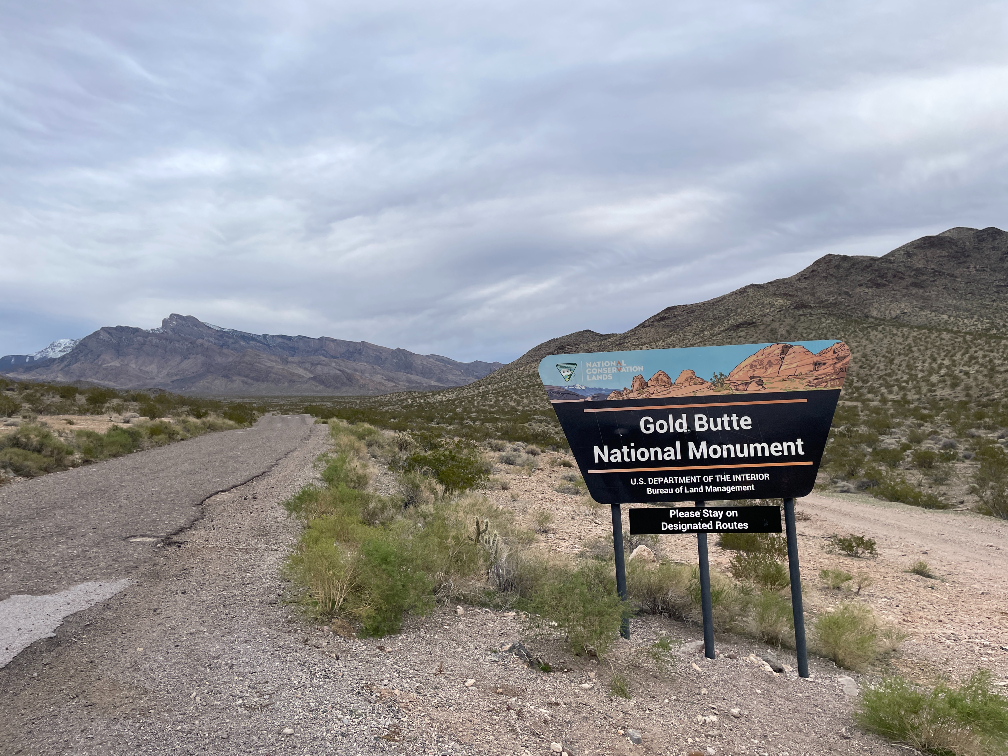
The road into Gold Butte National Monument is one of the biggest reasons the area remains remote. The road is paved according to the map but it might be smoother if it was not paved at all. Most of the pavement has eroded into random potholes of every size and the washboarding is very pronounced, resulting in a long, slow, teeth rattling, car shattering, twenty miles.
We love the unloved places and can find beauty anywhere, but I have to admit: the scenery for most of this drive is dull. I’m certainly not selling this park! But I would rather scare away the unprepared. If you can handle this so far, then stick around, it’s gonna get good…
Suddenly, you turn another bend and ….(angels singing)…In the distance a blob of red sandstone catches your eye!
Monument Loop Road
The beautiful red rock formation on both sides of the road is called Whitney Pocket. Cross the cattle grate and breathe a sigh of relief—you made it!
Here the “pavement” ends and good old dirt begins. If your vehicle is bigger than an SUV, this is where you park it. Also here at Whitney Pocket is the dispersed camping (more on camping below).
This road splits into a big loop and both splits degrade quickly into tight turns and eroded washes. Stock 4WDs, and better, are recommended (more on vehicle choice below). Know your vehicle’s limits and the limits of your driving skill.
The split road creates a huge loop that will take most of the day to drive, longer than it looks on the map. But there’s lots of points of interest. There are also roads that lead outside the Gold Butte National Monument boundary including into Grand Canyon-Parashant National Monument (if you’re nm bagging).

Vehicles: Is a 4WD required to get to Gold Butte National Monument?
Nimble, high-clearance 4WD vehicles are recommended.
We drove our tow vehicle to see the sites within the monument: a Jeep Grand Cherokee with 4WD high/lo and skid plates which handled the road perfectly and allowed us to carry food and dogs in comfort. Most visitors were in Off Road Vehicles (OHV) or All-Terrain Vehicles (ATV) which they drove in. These can be rented in the nearby towns of Moapa Valley or Mesquite. Motorcross-style dirt bikes and mountain bikes can be used too, if they are unloaded after the bumpy 30 miles of Gold Butte Road.
We do not recommend full-sized pick-up trucks or larger rigs on these roads. Our GMC Sierra pick-up truck would not have made the tight turns and eroded washes. A nimble, high-clearance 4WD is recommended. We drove our Class C RV those 20 miles to Whitney Pocket—NOT recommended.
According to Google there is also a camel rental.
Can I camp in Gold Butte National Monument?
Yes! And it is free to camp.
Attention Big Rigs: Bumper Pulls, Fifth Wheels, Class A, B, or C rigs:
The prettiest site in the park is also the first one you come across at Whitney Pocket (right hand side, can’t miss it) and it is also the ONLY ONE large spot for bigger rigs and trailers. We were extremely lucky to find this spot free after driving that road. We didn’t see any other spots that would have been suitable. This is also the only place where larger rigs can turn around. Instead, consider staying at one of the RV resorts in Mesquite and enjoying Gold Butte as a day trip.

Attention Small Rigs: trailer pods, camper-over-truck, Overlanders, camping vans, car campers, and tenters
Rigs with a smaller footprint have the advantage of choosing other spots. So please don’t take the big spot described above. There are plenty of other options for you. Just after the first big spot at the same rock formation are sites to the right. Another interesting rock formation is on the left and there are also campsites there.
Sites are first come, first served. All the sites are in the native landscape so they are alternately tiny or large, eroded or somewhat level. Every site is different. The smaller footprint you have, the easier it will be to find a suitable campsite. Most of the sites are spaced out but they are only semi-private. There are also spots along the loop road.
Let me repeat, there are no services.
This is boondocking! The first rule to boondocking is to come prepared: if you might need it, bring it.
Due to the wide-open skies, Starlink works great!
Second rule of boondocking is to use “disturbed ground”—a place in nature that has already been used by people before you. Look for clues like a stone campfire ring, brown stake that says “dispersed camping”, maybe even a picnic table or metal fire ring. Some sites will have a string of rocks defining a boundary. If it’s not obviously a campsite, don’t camp there. The remoteness and nature of this park are why any of us visit—let’s keep it looking natural while we recreate.
Camping Beyond Gold Butte National Monument
This whole area where Nevada, California, and Arizona meet is excellent for winter camping. There are so many places to camp from boondocking to full hook ups to cabins and seasonal rentals. Staying in the area for an extended time give you plenty of opportunities for day trips to check out interesting places.
Check out another of our favorites national monuments in the southwest:
Mojave National Preserve
What is there to see and do in Gold Butte National Monument?
There are a surprising number of sites to see. I’m only going to review the top four. If you find these interesting enough to visit, then I encourage you to dig deeper on the map for the additional sites like the petroglyph sites and slot canyons. Rocks are the big thing here, on a massive scale and the tiny scale.
Whitney Pocket
Whitney Pocket is the first highlight. It’s that first cool rock formation where I told you to camp. Hike around right there! If you are camping, this is an excellent place to take dark sky photos.
On the left is a sign for a dam. The dam is an old historic project to capture rainwater in the rock bulge and funnel it into a small natural rock reservoir. Your backyard pool is bigger. Included is a set of narrow, concrete steps with no guard rail that allow you to see the empty pool from above.


Drive The Gold Butte Loop Road
For an all-day experience, take a lunch and snacks, the dog and water, chairs and hiking boots to explore all of Gold Butte National Monument. Points of interest are far between. Signage is surprisingly good but won’t tell you about everything, neither will maps. Plan to get out often to explore on foot.
We spent about 8 hours traveling and exploring the entire loop. It was a beautiful sunny day in February of 2024 and we saw only a handful of other visitors. Two groups were ATVers—retirees with coolers and dogs. We saw one group of motorbikes–retirees again, no coolers, no dog, no shade (fools), and we saw two single Jeeps.
After having taken the whole loop, we don’t recommend taking the whole loop. Take the right fork and turn around when you’ve had enough.
The Devils Throat
Off the right fork, the next point of interest is the Devil’s Throat. Some call it the Devil’s Nostril. A better name for it would be the literal butt of even more jokes.

This is a big sinkhole with a ramshackle fence around it. Look for the excellent interpretive sign that lets you know that the fence was put up when the hole was smaller. If the concrete steps at the dam didn’t give you the willies, the Nostril will.
Little Finland
Little Finland is the reason you are in Gold Butte National Monument. Bigger and awesomer than Whitney Pocket, this red sandstone formation is not even listed on the paper maps and Google maps (user made) doesn’t exactly have the location right.
Though huge, it’s actually hard to see from the road. You’re driving along in a wash and a small but wide slot canyon is building up around you…
Uh, sorry, … that’s directions to almost every place in the desert.
Look for an interesting rock arch by the roadside. Park on the disturbed ground along the wash and climb up over the embankment of the slot canyon (it’s not hard).

And prepared to be floored.
The red sandstone blob here is glorious. There’s nooks and crannies where softer rock eroded away by wind and rain over eons leaving little caves with baby bottom soft sand below and evidence of the cliff swallows above. Tiny desert wildflowers shyly poke from eroded cracks in the sandstone that are soft boulders continually sanded smooth by the wind.


Photography at Little Finland
As a hobbyist photographer, I couldn’t take enough pictures to capture it. Capturing it in the golden hours of sunrise and sunset would be unparalleled. But being there at those times of day can only be done safely by camping here. The road is too tight and eroded to risk driving in the dark.
While you are here, sit in the shade of the hollowed out rock ledges. Or lay down on a smooth slab of rock and watch the billowy clouds go by. Lay on your stomach on the un-warmed rock to photograph the miniscule spring wildflowers and tiny Mammillaria cacti clinging to life. Maybe a bee will come by and you’ll notice the absolute quiet except for the singing grains of sand being scoured from the rocks.
This is the place you came to see. Linger here. Have a picnic. After this spot, I recommend turning back.
Committed to getting to the town of Gold Butte?
But maybe you’re like, “Let’s keep driving, we got time and how boring can it possibly be?” Go right ahead, take the whole loop. At the farthest point out, you will see the reason why Gold Butte is called Gold Butte.
Spoiler alert: There’s no gold at Gold Butte. The fact that there was no gold was such a disappointment that the settlers who built a little town here (two homes and a church) gave it up. There’s not even ruins anymore, just the interpretive sign.

Why bother with the sign? Because after driving all this way, there needs to be something. One Google review said it was a ghost town. It’s not even a ghost of a ghost town. Now you get to drive all the way back.
Wrap up: Is Gold Butte National Monument worth it?
We still talk about our visit to Gold Butte with awe: absolute hidden beauty. But was it worth it?
Where’s the gold? For us, it’s having the monument to ourselves. You can’t find gold like that in the hustle and bustle of Las Vegas. You can’t find solitude like this in the packed parking lots of better known nature parks like Valley of Fire just on the outskirts of Vegas.
If you are like us, you would rather gamble on taking a bad road that leads to nature’s hidden beauty.
Then maybe the road to Gold Butte National Monument should simply stay as bumpy and unwelcoming as it is.


Leave a Reply